
The Gasherbrums (I & II)
Two 8,000ers sharing one basecamp — the connoisseur's pair.
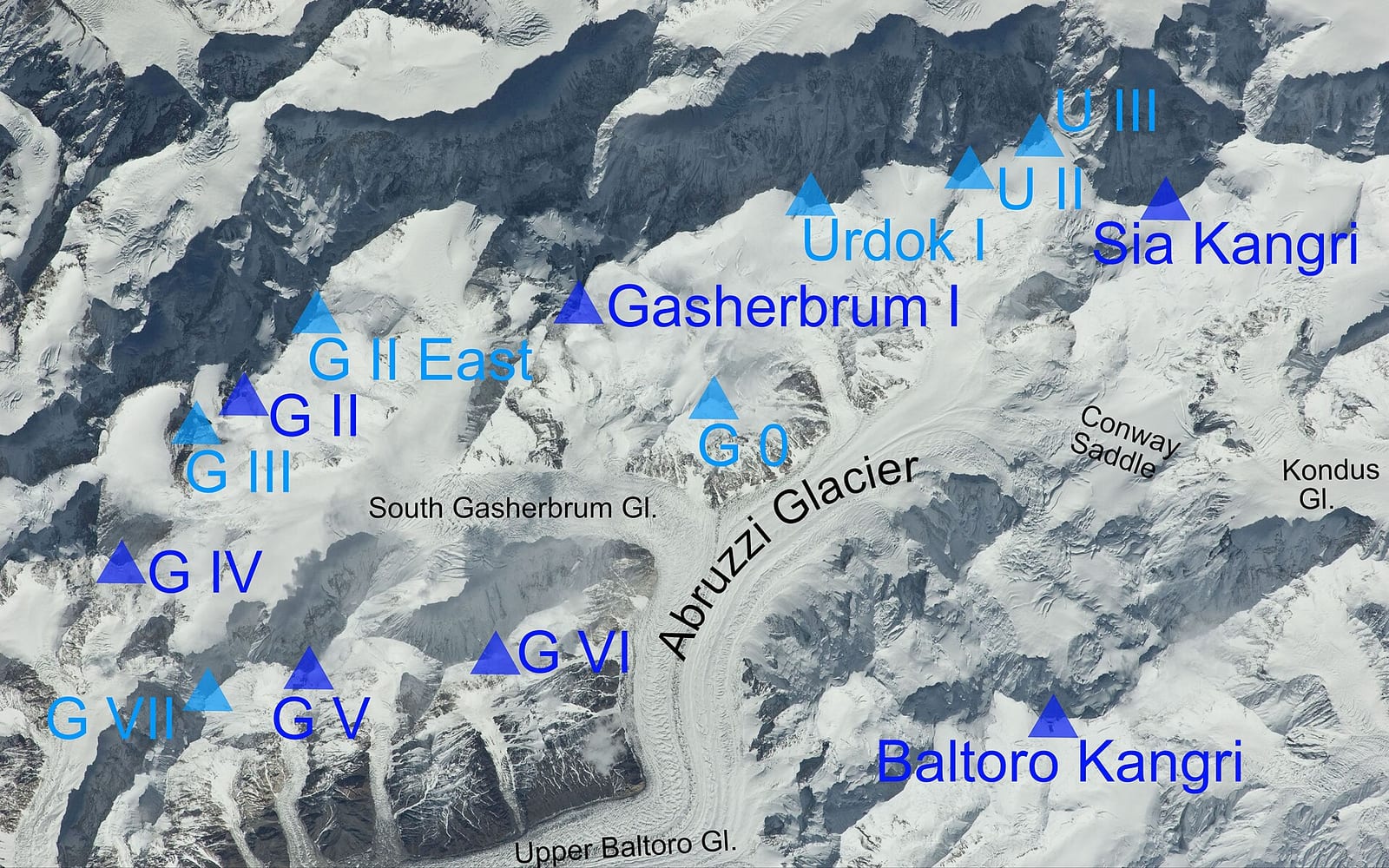
Gasherbrum I (8,080 m, 'Hidden Peak') and Gasherbrum II (8,035 m) are the Karakoram's quietly paired 8,000ers at the Baltoro's head — GII being the range's most 'achievable' 8,000 m climb and a standard first-eight-thousander, GI its sterner hidden sibling. Trekkers on the Concordia route see the massif's shining wall (Gasherbrum IV, 7,925 m) dead ahead for days — one of trekking's great sustained views.
| Elevation | 8,080 m (GI) / 8,035 m (GII) |
| World rank | 11th & 13th highest on Earth |
| Range | Karakoram (Gasherbrum massif, upper Baltoro) |
| First ascent | 1958 (GI, American) / 1956 (GII, Austrian) |
| Where it stands | At the head of the Baltoro beyond Concordia, on the Pakistan–China border — the 'beautiful mountains' of the Balti name. |
Confusingly, the Gasherbrum that owns the trek is not the 8,000ers at all: Gasherbrum IV's west face — the 'Shining Wall' — is the golden screen that fills the Baltoro's axis from Goro to Concordia, and its 1985 ascent by Kurtyka and Schauer is often called the greatest alpine climb ever done.
GII's relative accessibility makes it the sensible 8,000er ambition for strong trekkers turned aspirant mountaineers — a natural next chapter after a SafarGB K2 BC season, and our expedition desk brokers exactly that progression.
Questions, answered
Which Gasherbrum do trekkers actually see?
Mostly Gasherbrum IV — its golden 'Shining Wall' owns the upper Baltoro's axis. GI hides behind (hence 'Hidden Peak'); GII shows itself near Concordia. All within one massif at the glacier's head.