
Masherbrum (K1)
The first Karakoram peak ever numbered — and the fiercest unclimbed face left.
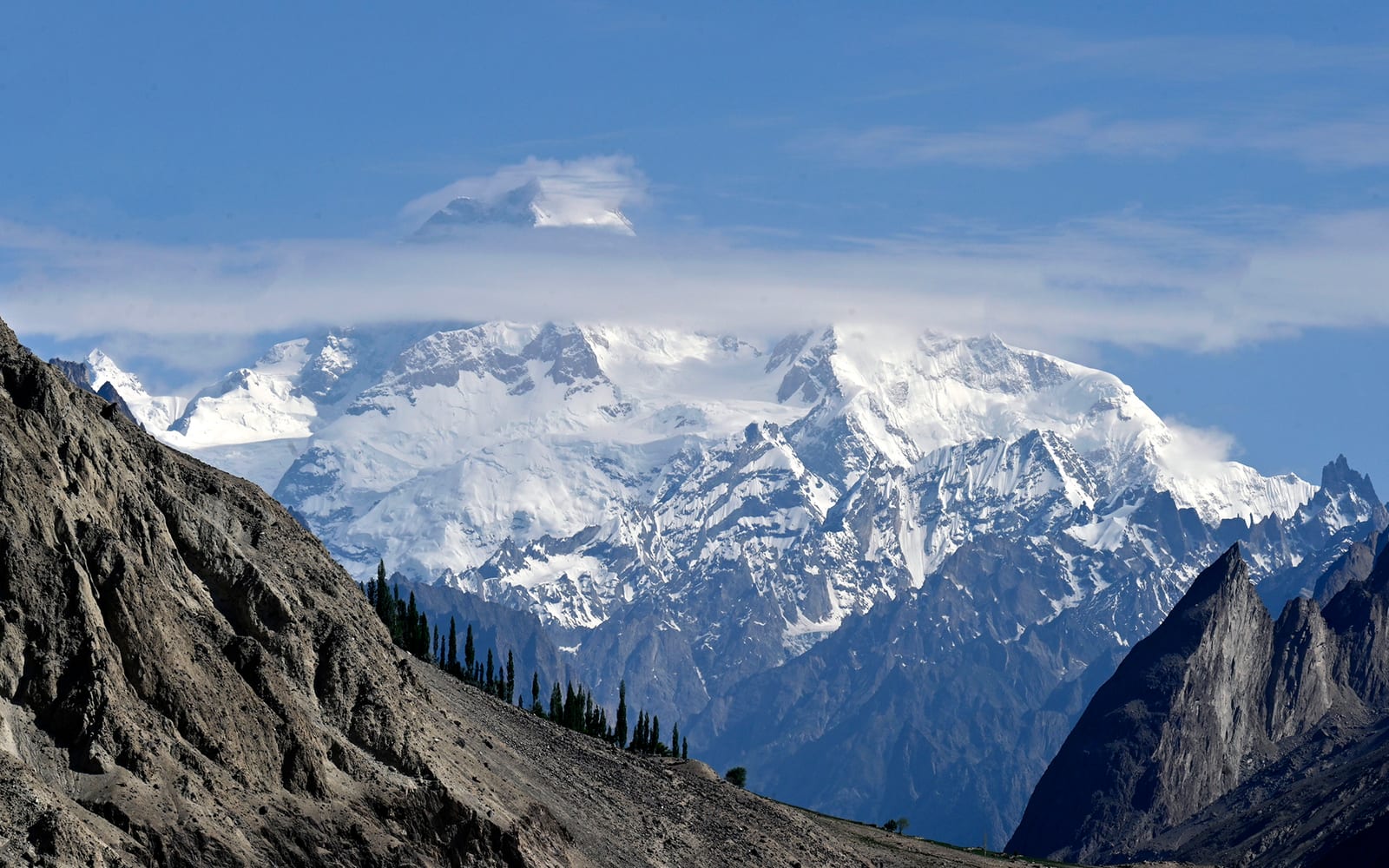
Masherbrum (7,821 m) was 'K1' — the first peak the 1856 Karakoram survey catalogued — and remains one of mountaineering's most respected summits: climbed only a handful of times, its northeast face is widely called the greatest unclimbed wall problem in the world. Travellers see it stately from Khaplu and the Hushe valley, and from the Baltoro's southern skyline on the K2 trek.
| Elevation | 7,821 m / 25,659 ft |
| World rank | 22nd highest on Earth |
| Range | Karakoram (Masherbrum Mountains) |
| First ascent | 1960 — George Bell & Willi Unsoeld (US-Pakistani) |
| Where it stands | Between the Hushe valley and the Baltoro — the 'K1' of the original survey; Khaplu Palace's balconies frame it. |
That 'K1' designation is a lovely irony: the mountain surveyed first has proven far harder to repeat than its more famous sibling K2 — barely four ascents in history, and the NE face has repelled the sport's strongest teams outright.
The civilised way to meet it is from Khaplu Palace's terrace, where it rises at the end of the Shyok like a stage backdrop; the committed way is the Hushe valley, whose villages have supplied the Karakoram's greatest high-altitude porters for three generations.
Questions, answered
Why is Masherbrum called K1?
It was the first Karakoram peak logged in the 1856 Great Trigonometric Survey — 'K' for the range, '1' for first observed. Its local name endured while K2's never did, so the numbering survives only on its more famous neighbour.